You’re scrolling through a group chat, a Discord server, or the comments on a viral post, and someone drops a single word: “tsk.” No explanation. No emoji. Just three letters that somehow carry an entire mood.
If you’ve ever paused and wondered what does tsk actually mean in texting, you’re not alone. It’s one of the most searched short-form expressions online, precisely because it looks like an acronym but isn’t one — and that mismatch is where most of the confusion starts.
This guide breaks down everything worth knowing about “tsk” in modern digital communication: where it came from, how different generations and platforms use it, why it gets misread so often, and how to respond to it naturally.
What Does TSK Mean in Text?
In texting and online conversation, “tsk” is the written form of a tongue-click sound — the same sharp, short click people make with their tongue against the roof of their mouth to express disapproval, annoyance, disappointment, or mild judgment.
It’s not an abbreviation for a phrase. It’s a sound spelled out, similar to how “ugh,” “hmm,” or “psst” represent noises rather than words. When someone types “tsk,” they’re recreating a vocal reaction in text form — something tone of voice would normally carry in a face-to-face conversation.
That’s the core definition. Everything else — the humor, the sarcasm, the community-specific spins — builds on top of that base meaning.
Where Did “TSK” Come From?
Unlike slang born on Twitter or in gaming lobbies, “tsk” didn’t start online at all. The tongue-click sound it represents has been used across many cultures for generations as a way to express disapproval without needing to say a full sentence — a parent reacting to a child’s mistake, a friend teasing another, a person expressing quiet frustration at bad news.
When text-based communication became the dominant way people talked — through SMS, instant messaging, and later social platforms — users needed shortcuts to carry tone that plain text usually strips away. “Tsk” filled that gap perfectly: one syllable, instantly recognizable, and universally understood without translation.
From there, it spread naturally into:
- Online forums and message boards
- Instant messaging apps
- Gaming voice-to-text chats and lobbies
- Fan communities and fandom spaces
- Social media comment sections and captions
Its staying power comes down to efficiency. A single word replaces a whole explanation of how someone feels.
The Many Meanings of TSK (Context Changes Everything)
While the tongue-click meaning dominates casual texting, “tsk” isn’t always used the exact same way. Context, tone, and platform all shape how it lands.
| Type | What It Signals |
|---|---|
| Emotional reaction | Disappointment, annoyance, or playful judgment (most common use) |
| Stylistic/dramatic reaction | Exaggerated for comedic effect in memes or joking exchanges |
| Acronym (rare, situational) | Occasionally used as initials for a business, project, or organization name |
| Community-specific meaning | Niche groups sometimes assign their own inside-joke interpretation |
In the overwhelming majority of everyday text conversations, the emotional-reaction meaning wins. If you see “tsk” in a group chat, a comment, or a caption, it’s almost certainly about tone — not an acronym.
Does TSK Stand For “To Share Knowledge”?
This is one of the most common mix-ups searchers run into. Because “tsk” looks like it should stand for something, people sometimes assume it’s short for a phrase — including “to share knowledge” or similar.
In casual texting, this is generally not accurate. The tongue-click meaning is dominant, and unless the surrounding conversation is clearly about an organization, brand, or specific project using “TSK” as initials, the acronym reading doesn’t apply.
For example:
“Tsk, you should have studied earlier.”
Here, “tsk” is expressing mild criticism — not referencing a knowledge-sharing phrase. When in doubt, let the sentence around it guide the interpretation.
Why Does TSK Have So Many Interpretations?
Language shifts fast, and the internet speeds that process up even further. A word that means one thing in a gaming server can mean something slightly different in a meme caption or a family group chat.
A few reasons “tsk” carries multiple shades of meaning:
- Different communities adopt it for different purposes — a gamer reacting to a missed shot isn’t using it the same way a content creator uses it for comedic timing.
- Tone changes everything. A serious “tsk” reads as genuine disappointment. A playful one between close friends usually signals teasing, not real criticism.
- Context does the heavy lifting. The same word, dropped into a serious message versus a joking one, can flip its emotional weight entirely.
Understanding this is the single most useful skill for reading “tsk” correctly — pay attention to the relationship between the people talking and the tone of the rest of the message, not just the word itself.
Who Uses TSK the Most?
No single age group or online community “owns” this expression, but usage patterns do differ:
| User Group | Typical Use | Common Tone |
|---|---|---|
| Gen Z | Irony, playful judgment | Casual |
| Gamers | Reacting to mistakes or losses | Competitive |
| Content creators | Comedic commentary, reaction captions | Entertaining |
| Professionals | Rare, only in informal chats | Lighthearted |
| Older users | Natural typed version of the spoken sound | Genuine/expressive |
Younger users tend to type it more often and more casually, frequently pairing it with emojis or exaggerated punctuation. Older users who grew up making the actual sound out loud often type it because it feels like the most natural way to express that specific reaction in writing.
Real Conversation Examples Using TSK
Seeing “tsk” in context makes its meaning much clearer than any definition alone. Here are five everyday scenarios:
1. Friends planning an outing
“Tsk, you forgot movie night again?” Reply: “I know. I’ll make it up to you next weekend.”
2. Gaming chat
“Tsk, we almost had that match.” Reply: “Next round we’ll do better.”
3. Sibling conversation
“Tsk, Mom specifically said no snacks before dinner.” Reply: “Okay, okay. I’ll wait.”
4. Social media comment
“Tsk, celebrities never learn.” Reply: “Some definitely don’t.”
5. Workplace group chat
“Tsk, the printer picked today to stop working.” Reply: “I’ll call IT support.”
Notice how the same word shifts in weight depending on who’s talking and what’s happening. Between siblings, it’s a light scolding. In a gaming chat, it’s a shared moment of frustration. In a workplace chat, it’s mild, harmless venting.
How TSK Shows Up Across Social Media Platforms
Usage also shifts slightly depending on where the conversation is happening:
| Platform | Typical Meaning | Common Use Case |
|---|---|---|
| TikTok | Playful disappointment | Reaction captions on videos |
| Mild judgment | Comment sections | |
| X (Twitter) | Frustration or sharper criticism | Trending topic discussions |
| Snapchat | Friendly teasing | Private, casual chats |
| Discord | Gaming reactions | Server and voice-chat conversations |
| General disapproval | Casual, everyday exchanges |
The underlying meaning stays consistent — disapproval or mild annoyance — but the intensity often shifts. X tends to carry sharper, more critical uses, while Snapchat and TikTok lean toward the lighthearted, joking end of the spectrum.
Common Misunderstandings About TSK
A surprising number of mix-ups happen simply because people apply the wrong lens to a short piece of slang. Watch out for these common mistakes:
- Assuming every short slang term must be an acronym. Not all internet shorthand stands for a phrase — some, like “tsk,” are just written sounds.
- Ignoring tone indicators in the rest of the message. Reading “tsk” in isolation, without the sentence around it, is where most misreadings start.
- Applying one platform’s tone everywhere. A sharp, critical “tsk” on X doesn’t necessarily translate the same way in a friendly Snapchat exchange.
- Mistaking playful teasing for real hostility. Between close friends, “tsk” is often affectionate mock-annoyance, not a genuine complaint.
- Confusing it with a typo. Because it doesn’t look like a “real word,” some readers assume it’s a typing mistake rather than intentional slang.
Recognizing the relationship between the people in the conversation is the fastest way to avoid misreading the tone.
How Gen Z Uses TSK Today
Gen Z rarely uses any slang in a purely literal way, and “tsk” is no exception. Tone, timing, and irony all shape what it actually communicates.
You’ll often see it:
- Paired with emojis or exaggerated punctuation to soften (or heighten) the criticism
- Used theatrically, more as a performance of disappointment than a genuine complaint
- Deployed to strengthen social bonds through shared humor rather than to express real frustration
There’s also an identity element at play. Shared expressions like this create a sense of belonging within a community — using the “right” slang, in the right way, signals that you’re fluent in the group’s particular sense of humor.
How to Reply When Someone Texts You “TSK”
Your response should match the tone the sender is going for — not the literal word.
- If it feels lighthearted: Respond with humor or a quick, casual acknowledgment. Overthinking a joking “tsk” can make the exchange feel more serious than intended.
- If it feels genuinely disappointed: Address the underlying concern directly. A short explanation, apology, or clarification usually resolves it faster than matching the tone back.
When unsure, it’s usually safe to ask lightly — “you okay?” or “was that a joke?” — rather than assuming the worst.
Tsk Tsk Tsk Meaning in Chat
“Tsk tsk tsk” in chat is a written expression of disapproval, disappointment, teasing, or mild annoyance.
People use it when they want to say “that’s not good,” “you shouldn’t have done that,” or “oh no” in a playful way.
In Gen Z conversations, it can also be sarcastic, funny, or used as a dramatic reaction.
Tsk Meaning in Chat From a Girl
When a girl texts “tsk,” it often shows playful disappointment, teasing, or a small complaint.
The meaning depends on the conversation — it can be a cute reaction, a sarcastic reply, or a sign she disagrees.
For example, “Tsk, you forgot again” may mean she is jokingly calling you out.
Tsk Meaning in WhatsApp
On WhatsApp, “tsk” is usually used as a text sound showing annoyance, disbelief, or disappointment.
It replaces the real-life tongue-clicking sound people make when reacting to something.
The tone can range from friendly teasing to serious disapproval depending on the message.
Tsk Full Form
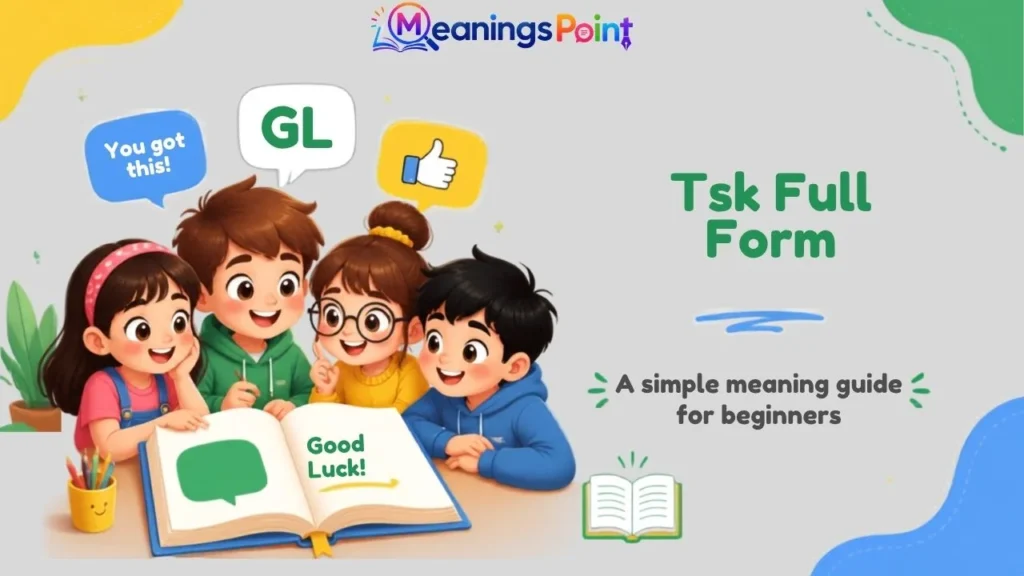
“Tsk” does not have an official full form because it is not an acronym.
It is an onomatopoeic expression that represents the sound of clicking your tongue.
People write “tsk” in chats to express reactions instead of using words.
Tsk Meaning in Instagram
On Instagram comments or DMs, “tsk” is used as a quick reaction to something surprising, wrong, or funny.
It may show playful judgment, sarcasm, or a “come on, really?” feeling.
Creators and Gen Z users often use it to add personality to their replies.
Tsk Meaning in Gen Z
Among Gen Z, “tsk” is often used as a dramatic or sarcastic reaction rather than serious criticism.
It can mean “not impressed,” “you messed up,” or “I’m teasing you.”
The meaning changes with emojis, context, and the relationship between people.
Tsk Pronunciation
“Tsk” is pronounced like a short clicking sound made with the tongue, similar to “tisk.”
It is usually not spoken as separate letters; it is a sound expression used in writing.
The pronunciation shows a feeling of disapproval, surprise, or playful annoyance.
What Does Tsk Mean in Snapchat
On Snapchat, “tsk” usually means a person is reacting with mild disappointment, teasing, or disbelief.
Friends may use it as a funny response to snaps, stories, or messages.
The meaning depends on the sender’s mood — it can be playful, sarcastic, or slightly annoyed.
Related Slang Terms Worth Knowing
“Tsk” is part of a much bigger family of short-form digital expressions. A few common ones you’ll likely run into alongside it:
- SMH — Shaking My Head
- IDC — I Don’t Care
- TBH — To Be Honest
- IMO — In My Opinion
- NGL — Not Gonna Lie
- FR — For Real
- IKR — I Know, Right?
- FOMO — Fear Of Missing Out
- IDK — I Don’t Know
- BRB — Be Right Back
Knowing these helps you read the overall tone of a conversation faster, since slang terms rarely appear alone — they usually stack together to build a fuller emotional picture.
People also search
Tsk meaning in WhatsApp
Tsk full form
Tsk meaning in text from a guy
Tsk meaning in chat from a girl
Tsk meaning in gen z
Tsk meaning in text urban dictionary
Tsk pronunciation
Tsk sound
Frequently Asked Questions
What does tsk mean in text slang?
Tsk is a text expression showing disapproval, disappointment, annoyance, or a small complaint.
It is similar to the sound people make by clicking their tongue in real-life conversations.
In chats, “tsk” can mean “that’s not good” or “come on, really?”
What does tsk tsk mean in Gen Z?
Tsk tsk is used by Gen Z to playfully judge, tease, or show mild disappointment.
It can add a dramatic or funny reaction when someone makes a mistake.
The meaning depends on the context, from joking criticism to real disapproval.
Can “tsk” be used sarcastically?
Yes, tsk can be used sarcastically to create a playful or exaggerated reaction.
People often use it online to pretend they are judging someone in a funny way.
For example, “Tsk, you really did that?” can sound teasing rather than serious.
How do you say tsk tsk in text?
People write it as “tsk,” “tsk tsk,” “tsktsk,” or “tsk…” in messages.
The extra words or dots can make the reaction feel more dramatic or expressive.
It is commonly used in casual chats, comments, and social media replies.
What does tsk mean in Snapchat?
On Snapchat, tsk usually means a quick reaction of disappointment or playful judgment.
It is not a special Snapchat abbreviation but a common internet expression.
Friends may use it to react humorously to snaps or conversations.
What is tsk in chats?
In chats, tsk represents a sound of annoyance, disbelief, or mild criticism.
It works like saying “oh no,” “come on,” or “that’s disap.
Final Thoughts
At its core, TSK meaning in text is about emotion, not information. It compresses annoyance, disappointment, and playful judgment into a single, efficient word — something a full sentence would take much longer to convey.
The key to reading it correctly isn’t memorizing a fixed definition. It’s paying attention to tone, platform, and relationship — the same three things that shape meaning in any human conversation, spoken or typed.

Asfa Rani is a professional content writer and the author behind MeaningsPoint.com, passionate about making word meanings simple, accurate, and accessible for everyone.